
Co-Wash Products: Formulation and Manufacturing Opportunities for Textured Hair Brands
Co-wash products are cleansing conditioners developed to gently cleanse hair while providing conditioning benefits in the same washing step. They are particularly relevant for brands targeting curly, coily, natural, and textured hair customers who prefer a conditioning-focused cleansing routine.
Unlike conventional shampoos that primarily focus on removing oil and buildup, co-wash formulations combine suitable cleansing ingredients with conditioning agents, emollients, and other ingredients designed to improve hair manageability and softness.
For brands developing specialized textured hair care collections, HODM supports custom hair care formula development and hair care R&D services to help evaluate product concepts, ingredient systems, formula characteristics, and manufacturing requirements.
This guide explains how to develop co-wash products for textured hair brands, including cleansing conditioner formulation, ingredient selection, curly hair care, packaging, product testing, and OEM/ODM manufacturing opportunities.
1. What Are Co-Wash Products and How Do They Work?
Co-wash, short for conditioner washing, is a hair cleansing approach that uses a conditioning-focused product to clean the hair and scalp without following the same cleansing approach as a traditional shampoo.
Co-wash products are commonly developed as cleansing conditioners. They combine selected cleansing ingredients with conditioning components to help remove some surface oils, sweat, and everyday impurities while maintaining a conditioning-focused hair feel.
How Co-Wash Cleansing Works
A co-wash formula typically uses a mild cleansing system together with conditioning ingredients. The cleansing components help loosen and remove some impurities, while conditioning agents and emollients support softness, smoothness, and manageability.
Why Co-Wash Is Relevant to Textured Hair Brands
Curly and coily hair can be more prone to tangling, dryness, and mechanical stress during grooming. Many textured hair customers therefore look for cleansing products that combine cleansing with conditioning.
Co-wash can provide an additional cleansing option within a broader hair care routine, particularly between deeper cleansing sessions.
Co-Wash Is Not the Same as Regular Conditioner
A standard conditioner is primarily designed to condition the hair after cleansing. A co-wash is developed with a suitable cleansing system so that it can perform a cleansing function while also providing conditioning benefits.
Co-Wash vs. Shampoo vs. Conditioner
| Product | Primary Function | Formula Direction |
|---|---|---|
| Traditional Shampoo | Cleansing | Surfactant-focused system |
| Regular Conditioner | Conditioning and detangling | Conditioning-focused system |
| Co-Wash | Gentle cleansing and conditioning | Combined cleansing and conditioning system |
| 2-in-1 Shampoo | Cleansing and conditioning | Shampoo-based cleansing with conditioning agents |
The key difference is the balance between cleansing and conditioning. Co-wash is not simply a regular conditioner with a different product name.
2. Why Co-Wash Products Are an Opportunity for Textured Hair Brands
Co-wash products create opportunities for brands targeting customers who prefer conditioning-focused cleansing routines, especially in curly and textured hair care markets.
Growing Interest in Specialized Curl Care
Curly and coily hair customers often build routines around cleansing, conditioning, detangling, moisturizing, and styling. Co-wash can serve as an additional product within these routines.
Products for Between-Wash Routines
Some customers use cleansing conditioners between regular shampoo washes. Brands can develop products positioned for these selected routines rather than presenting co-wash as a universal replacement for shampoo.
Opportunities for Natural and Textured Hair Brands
Brands focusing on natural hair care can develop co-wash products with selected botanical ingredients, oils, conditioning agents, and fragrance directions.
Professional Salon and Specialty Retail
Co-wash products can complement professional salon collections, textured hair product ranges, and specialty retail offerings.
Product Line Expansion
A co-wash can be developed alongside curl conditioners, leave-in products, hair masks, detangling treatments, and styling creams to create a more complete textured hair care collection.
Potential Customer Groups
- Curly and coily hair brands.
- Natural hair care businesses.
- Textured hair specialists.
- Professional salons and stylists.
- Beauty retailers and distributors.
- Specialized ecommerce and DTC brands.
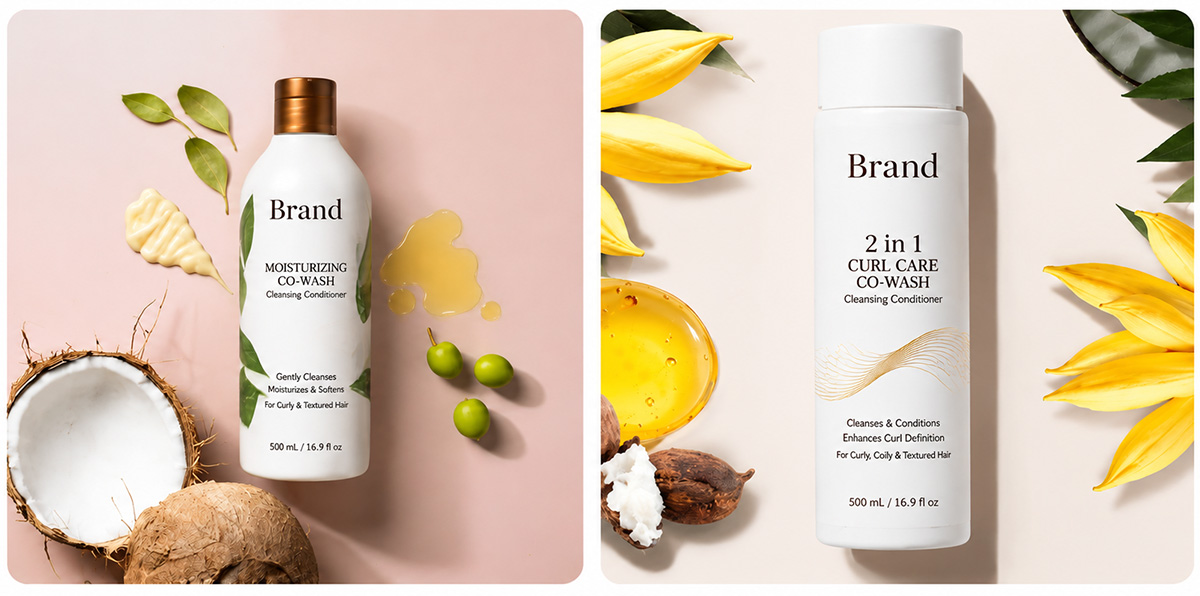
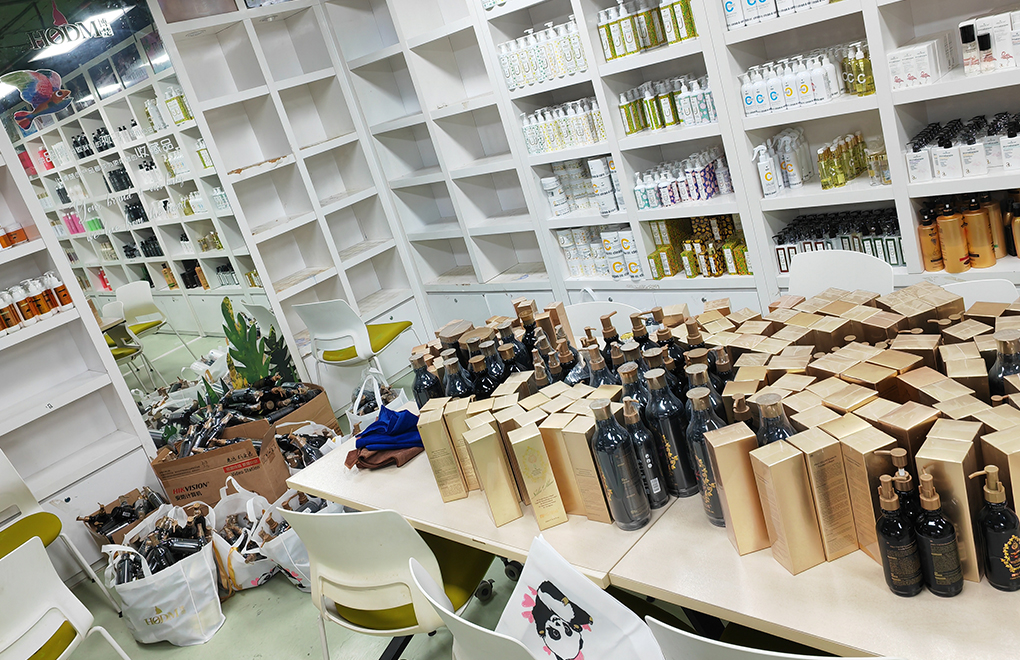
Cleansing conditioner product concepts developed for curly, coily, and textured hair care collections.
3. Types of Co-Wash Products Brands Can Develop
Different co-wash concepts can be developed according to target hair types, cleansing requirements, conditioning preferences, and product positioning.
Moisturizing Co-Wash
Moisturizing co-wash focuses on gentle cleansing combined with conditioning and emollient ingredients. It can target customers who prefer a softer, more conditioned feel during washing.
Curly Hair Co-Wash
Curly hair co-wash products can be developed with conditioning systems designed to support softness, detangling, and curl manageability.
Coily and Textured Hair Co-Wash
These products may use richer conditioning systems and suitable emollients to support the needs of customers with tightly curled or coily hair.
Lightweight Cleansing Conditioner
A lightweight co-wash can target customers who prefer conditioning without an excessively rich or coated finish.
Botanical Co-Wash
Botanical-focused concepts can incorporate selected plant extracts and oils according to the brand's ingredient preferences and formula requirements.
Silicone-Free Co-Wash
Brands may develop silicone-free cleansing conditioners for customers seeking a particular ingredient profile. The formula should still provide suitable cleansing, conditioning, and sensory performance.
Compare Co-Wash Product Directions
| Product Type | Target Customer | Development Focus |
|---|---|---|
| Moisturizing Co-Wash | Dry and curly hair | Conditioning and softness |
| Curly Hair Co-Wash | Wavy and curly hair | Detangling and manageability |
| Coily Hair Co-Wash | Coily and textured hair | Richer conditioning |
| Lightweight Co-Wash | Fine or easily weighed-down hair | Balanced conditioning |
| Botanical Co-Wash | Botanical-focused customers | Ingredient positioning |
| Silicone-Free Co-Wash | Specific ingredient preferences | Alternative conditioning system |
4. Co-Wash Formulation: Building a Balanced Cleansing and Conditioning System
Co-wash formulation requires balancing cleansing performance with conditioning characteristics. A formula that cleanses too aggressively may not deliver the intended co-wash experience, while an overly rich conditioning system may leave unwanted buildup or an excessively coated feel.
Select a Suitable Mild Cleansing System
Depending on the product concept, formulators may evaluate suitable amphoteric, nonionic, or other mild cleansing ingredients.
Ingredient options may include Cocamidopropyl Betaine, Coco-Glucoside, and other compatible surfactants. The selection should reflect the desired cleansing strength and complete formula structure.
Balance Cleansing and Conditioning Ingredients
A co-wash requires sufficient cleansing capability while maintaining the conditioning characteristics expected from a cleansing conditioner.
Formulators may evaluate conditioning agents, fatty alcohols, emollients, and other suitable ingredients to create the intended formula texture and performance.
Control Formula Viscosity
Viscosity affects application, distribution through the hair, dispensing, and rinsing. A rich cream texture may suit some textured hair products, while a lighter lotion may be more appropriate for other customer groups.
Consider Low-Foam and Non-Foam Systems
Co-wash products may be developed as low-foam or non-foam cleansing conditioners. However, foam level is not the only measure of cleansing performance.
The complete formula should be evaluated for cleansing, application, rinsability, and finished hair feel.
Evaluate Rinsability
A co-wash should rinse appropriately according to its intended use. Excessive residue or a heavy after-feel may reduce the product's suitability for some hair types.
5. Key Ingredients Used in Co-Wash Products
Ingredient selection plays an important role in co-wash formulation. The final system may combine mild cleansing ingredients with conditioning agents, fatty alcohols, emollients, humectants, and selected botanical materials.
Mild Cleansing Ingredients
Mild cleansing ingredients help loosen and remove selected impurities while supporting the intended cleansing experience.
- Cocamidopropyl Betaine: An amphoteric surfactant used in selected cleansing systems.
- Coco-Glucoside: A nonionic surfactant used in certain gentle cleansing formulations.
- Other Compatible Surfactants: Selected according to cleansing strength, compatibility, and formula requirements.
Conditioning Agents
Conditioning ingredients contribute to the softness, smoothness, and manageability of the finished product.
- Behentrimonium Methosulfate: A conditioning ingredient used in selected conditioner systems.
- Cetrimonium Chloride: A conditioning agent used in suitable hair care formulations.
- Behentrimonium Chloride: A conditioning ingredient used in selected rinse-off and conditioning products.
Fatty Alcohols
Cetearyl Alcohol, Cetyl Alcohol, and Stearyl Alcohol may contribute to formula structure, texture, and conditioning characteristics.
Plant Oils and Emollients
Argan oil, coconut oil, jojoba oil, olive oil, and shea butter may be considered according to the desired conditioning level and sensory profile.
Humectants
Ingredients such as Glycerin and other suitable humectants can contribute to the formula's moisture-related characteristics.
Proteins and Botanical Extracts
Hydrolyzed proteins, aloe vera, botanical extracts, and other supporting ingredients can be selected according to the brand's product concept and formulation requirements.
Ingredient Functions in Co-Wash Formulation
| Ingredient | Potential Function | Formulation Consideration |
|---|---|---|
| Cocamidopropyl Betaine | Mild cleansing | Surfactant balance |
| Coco-Glucoside | Nonionic cleansing | Compatibility |
| Behentrimonium Methosulfate | Conditioning | Formula structure |
| Cetrimonium Chloride | Conditioning support | Compatibility with cleansing system |
| Cetearyl Alcohol | Texture and emulsion structure | Viscosity |
| Glycerin | Humectant function | Sensory balance |
| Argan Oil | Emolliency | Formula weight |
| Shea Butter | Emolliency and richness | Rinsability and texture |
| Panthenol | Conditioning support | Formula compatibility |
Not every co-wash needs all these ingredients. The final combination and concentrations should be determined through formulation development, compatibility testing, and performance evaluation.
6. Developing Co-Wash Products for Curly, Coily, and Textured Hair
Textured hair includes different curl patterns and hair characteristics. A successful co-wash collection should consider these differences instead of assuming that one formula is suitable for every customer.
Co-Wash for Wavy Hair
Wavy hair products may benefit from balanced conditioning and a formula that does not leave the hair feeling excessively heavy.
Co-Wash for Curly Hair
Curly hair products can focus on softness, detangling, and manageability while maintaining an appropriate cleansing function.
Co-Wash for Coily Hair
Coily hair collections may consider richer conditioning systems, emollients, and formula textures designed for the needs of tightly curled hair.
Co-Wash for High-Porosity Hair
Brands targeting customers with high-porosity or chemically processed hair may explore more conditioning-focused product concepts. The finished formula should still be evaluated for residue, rinsability, and overall performance.
Co-Wash for Low-Porosity Hair
Customers with low-porosity hair may prefer products that provide conditioning without excessive product deposition. Lighter formula directions can be explored according to the target market.
Product Development by Hair Type
| Target Hair Type | Product Direction | Development Focus |
|---|---|---|
| Wavy Hair | Lightweight Co-Wash | Balanced conditioning |
| Curly Hair | Moisturizing Co-Wash | Softness and detangling |
| Coily Hair | Rich Cleansing Conditioner | Conditioning and manageability |
| High-Porosity Hair | Conditioning-Focused Co-Wash | Softness and formula balance |
| Low-Porosity Hair | Lightweight Co-Wash | Residue and rinsability |
7. How to Build a Complete Co-Wash Product Line
Co-wash can serve as the foundation of a specialized textured hair care collection. Brands can develop complementary products to support different stages of a hair care routine.
Core Co-Wash Collection
- Moisturizing Co-Wash Cleansing Conditioner.
- Rich Conditioning Treatment.
- Leave-In Conditioner.
Curly Hair Collection
- Curly Hair Co-Wash.
- Deep Conditioning Mask.
- Leave-In Curl Conditioner.
- Curl Defining Cream.
Coily Hair Collection
- Rich Cleansing Conditioner.
- Intensive Moisturizing Mask.
- Detangling Leave-In Treatment.
- Styling Butter or Curl Cream.
Professional Textured Hair Collection
- Professional Co-Wash.
- Deep Conditioning Treatment.
- Detangling Cream.
- Leave-In Conditioner.
- Finishing Hair Oil.
Maintain a Clear Product Position
Avoid developing multiple products with nearly identical functions. Each product should have a clear role within the collection, such as cleansing, deep conditioning, detangling, or styling.
Explore HODM Conditioner Product Development for additional conditioning product opportunities.
8. Customize Co-Wash Texture, Fragrance, and Sensory Experience
Texture and fragrance influence the overall application experience of cleansing conditioner products. These characteristics should be considered alongside cleansing and conditioning performance.
Choose the Right Co-Wash Texture
- Lightweight cleansing conditioner.
- Creamy low-foam co-wash.
- Rich conditioning cleansing cream.
- Botanical cleansing conditioner.
Develop a Suitable Fragrance
Brands can explore fresh, floral, fruity, herbal, botanical, and warm fragrance directions according to their target customers.
Consider Fragrance Compatibility
Fragrance should be compatible with the complete cleansing conditioner formula. Its concentration and sensory performance should be evaluated in the finished product.
Evaluate Application and Rinsing
Review how easily the formula spreads through wet hair, whether it distributes evenly, and whether it rinses appropriately without an undesirable heavy finish.
9. Packaging Options for Private Label Co-Wash Products
Packaging should be selected according to the formula's viscosity, application method, product capacity, and target market.
Bottle Packaging
Bottles are a practical option for many cleansing conditioner products. Different capacities and shapes can be selected according to retail, salon, or professional use.
Pump Bottles
Pump bottles can provide convenient dispensing for selected co-wash formulas. The pump should be evaluated using the actual formula viscosity.
Squeeze Tubes
Tubes can be considered for thicker cleansing conditioner creams and travel-size products.
Custom Packaging and Branding
Brands can customize container colors, labels, printing, closures, and other packaging details to create a consistent textured hair care collection.
Packaging Considerations
- Formula viscosity and dispensing.
- Bottle or tube material compatibility.
- Closure and leakage performance.
- Product capacity and usage quantity.
- Labeling and brand identity.
- Transportation and storage requirements.
Explore HODM Custom Packaging Solutions for suitable bottles, pumps, tubes, and packaging customization.
10. Co-Wash Sample Evaluation, Testing, and Quality Control
Co-wash products should be evaluated for both cleansing and conditioning performance. A product that feels rich and smooth may still require additional assessment of its cleansing effectiveness and rinsability.
Evaluate Cleansing Performance
Assess whether the product removes the intended level of surface oils and everyday impurities under its recommended application conditions.
Evaluate Conditioning Performance
- Wet combing and detangling.
- Hair softness and smoothness.
- Spreadability through textured hair.
- Rinsability and finished hair feel.
- Residual coating or unwanted buildup.
Check Formula Stability
Evaluate changes in appearance, fragrance, viscosity, pH, and other relevant formula characteristics under appropriate storage conditions.
Microbiological Quality
Water-based cleansing conditioner formulas require suitable preservation systems and appropriate microbiological quality assessments.
Packaging Compatibility
Test the actual formula with the selected bottle, pump, tube, and closure. Check dispensing performance, leakage, and material compatibility.
Sample Approval Before Manufacturing
Record feedback from each sample evaluation, confirm any formula adjustments, and approve the final formula and packaging specifications before commercial production.
Read Hair Care Product Sample Evaluation: What Brands Should Check Before Approval for more information.
11. Co-Wash Manufacturing Process for Private Label Brands
Co-wash manufacturing requires suitable formula development, raw material control, mixing procedures, filling arrangements, and finished product inspection.
Step 1: Define the Product Concept
Identify the target hair type, cleansing strength, conditioning level, fragrance direction, texture, and desired product positioning.
Step 2: Select the Formula System
Decide whether to start with an existing cleansing conditioner concept or develop a customized formulation.
Step 3: Select Ingredients and Packaging
Confirm the cleansing ingredients, conditioning system, emollients, fragrance, and suitable dispensing components.
Step 4: Prepare and Evaluate Samples
Assess cleansing performance, conditioning feel, spreadability, rinsability, stability, and packaging compatibility.
Step 5: Approve Formula and Specifications
Confirm the final formula version, product specifications, fragrance, packaging components, and applicable quality requirements.
Step 6: Commercial Manufacturing
Production may involve raw material inspection, weighing, mixing, processing, filling, labeling, and packaging according to the approved product specifications.
Step 7: Finished Product Quality Inspection
Inspect finished product appearance, filling accuracy, packaging integrity, and other relevant quality requirements before release.
Step 8: Packing and Shipment
Confirm finished quantities, shipping cartons, product documentation, and delivery arrangements before dispatch.
Explore HODM Hair Care R&D and Product Development to discuss your product concept.
12. Custom Formulation for Private Label Co-Wash Products
Custom formulation allows brands to develop cleansing conditioner products according to their target customers, ingredient preferences, desired cleansing performance, and commercial positioning.
Prepare a Product Development Brief
- Target hair type: curly, coily, or textured hair.
- Desired cleansing strength.
- Conditioning level and finished hair feel.
- Preferred cleansing ingredients.
- Conditioning agents and emollients.
- Silicone-free or other ingredient preferences.
- Desired texture and viscosity.
- Fragrance direction.
- Packaging type and product capacity.
- Target market and product claims.
- Target cost and estimated MOQ.
Define the Cleansing and Conditioning Balance
The formula should provide the intended cleansing experience without losing its conditioning-focused product identity.
Develop Samples for the Target Hair Type
Evaluate samples on representative hair types and consider cleansing, detangling, softness, rinsability, and finished hair feel.
Refine and Approve the Formula
Record sample feedback, formula adjustments, and final specifications before moving toward commercial manufacturing.
Explore HODM Custom Formula Development to discuss your co-wash project.
13. Choosing a Co-Wash Manufacturer for Textured Hair Brands
Choosing a suitable co-wash manufacturer requires evaluating formulation expertise, cleansing and conditioning systems, sample development, packaging, and quality management.
Review Cleansing Conditioner Experience
Ask about the manufacturer's experience with cleansing conditioners, mild surfactant systems, conditioning ingredients, and textured hair product development.
Evaluate Formula Customization
Review the ability to adjust cleansing strength, conditioning level, ingredient selection, texture, fragrance, and product positioning.
Check Sample Evaluation Capabilities
Ask how the manufacturer evaluates cleansing, wet combing, conditioning, rinsability, stability, and packaging compatibility.
Understand MOQ and Production Requirements
Confirm minimum quantities for the formula, raw materials, finished products, and packaging components.
Review Manufacturing Quality
Consider raw material inspection, production documentation, batch consistency, microbiological controls, and finished product quality checks.
Confirm Commercial Project Support
A suitable manufacturing partner should help coordinate formula development, sample approval, packaging, production planning, and delivery requirements.
Explore HODM Conditioner Development and Manufacturing Guide for additional information.
14. Common Mistakes When Developing Co-Wash Products
Treating Co-Wash as a Regular Conditioner
A regular conditioner is not automatically suitable for co-washing. A co-wash requires an appropriate cleansing system alongside its conditioning components.
Using an Overly Aggressive Cleansing System
Excessive cleansing strength may conflict with the intended conditioning-focused product experience. The formula should be evaluated according to its target use.
Making the Formula Too Heavy
Excessive conditioning materials or emollients may leave unwanted residue or make the hair feel coated. Formula weight should match the target hair type.
Ignoring Rinsability
A co-wash should provide the intended conditioning feel while remaining practical to rinse out.
Using One Formula for Every Textured Hair Type
Different curl patterns and hair characteristics may require different conditioning levels, textures, and application experiences.
Making Unsupported Hair Growth or Repair Claims
Co-wash products should be positioned around appropriate cosmetic functions such as cleansing, conditioning, softness, and manageability. Therapeutic or unsupported claims should be avoided.
Frequently Asked Questions
What are co-wash products?
Co-wash products are cleansing conditioners designed to combine gentle cleansing with conditioning benefits. They are commonly used in curly, coily, and textured hair care routines.
What is the difference between co-wash and regular conditioner?
Regular conditioner primarily focuses on conditioning after shampooing. Co-wash is formulated with a suitable cleansing system so it can cleanse and condition hair in the same step.
Is co-wash the same as sulfate-free shampoo?
No. Sulfate-free shampoo is still a shampoo-based cleansing product, while co-wash is a conditioning-focused cleansing product with a different balance of cleansing and conditioning ingredients.
What ingredients are commonly used in co-wash formulation?
Depending on the formula, ingredients may include mild surfactants, conditioning agents, fatty alcohols, emollients, humectants, botanical extracts, and other supporting ingredients. The final combination depends on the desired cleansing and conditioning performance.
Are co-wash products suitable for curly and coily hair?
Co-wash products are commonly developed for curly, coily, and textured hair customers who prefer conditioning-focused cleansing routines. The formula should be tailored to the target hair type and intended use.
Can co-wash replace regular shampoo completely?
Not necessarily. Co-wash may suit selected between-wash routines, but it may not remove all types of heavy product buildup or excess oils as effectively as a suitable shampoo. Product use should depend on the hair care routine and cleansing needs.
Can brands develop silicone-free co-wash products?
Yes. Silicone-free co-wash formulations can be developed using suitable alternative conditioning systems and emollients. The finished formula should be evaluated for cleansing, conditioning, residue, and overall sensory performance.
What packaging is suitable for private label co-wash?
Bottles, pump bottles, and squeeze tubes can be considered depending on formula viscosity, dispensing requirements, and product positioning. Packaging compatibility should be tested using the actual formula.
Can co-wash products be customized for different hair types?
Yes. Brands can develop different cleansing strengths, conditioning levels, textures, and ingredient directions for wavy, curly, coily, and other textured hair categories.
Can HODM develop private label co-wash products?
HODM provides custom hair care formulation and product development support. Brands can discuss co-wash concepts, cleansing systems, conditioning ingredients, sample development, packaging, and manufacturing requirements with the HODM team.
Explore HODM Custom Formula Development.
Conclusion: Develop Co-Wash Products for the Textured Hair Care Market
Co-wash products offer opportunities for brands developing specialized cleansing and conditioning solutions for curly, coily, natural, and textured hair customers.
Successful product development requires a balanced cleansing system, suitable conditioning ingredients, appropriate formula texture, and a finished product that performs according to its intended use.
From moisturizing cleansing conditioners to lightweight curl care formulas, brands can develop different co-wash concepts that complement broader textured hair product collections.
By defining the target customer, formula requirements, packaging, and quality expectations early, brands can create more focused products and work toward a reliable manufacturing process.
Develop Your Own Co-Wash Products with HODM
HODM Cosmetics supports private label brands, salons, and distributors with custom hair care formulation, cleansing conditioner development, ingredient selection, packaging customization, and OEM/ODM manufacturing solutions.
Whether you are developing moisturizing co-wash, curly hair cleansing conditioners, or specialized products for textured hair, our team can discuss suitable formula concepts and manufacturing requirements.
Share your target hair types, preferred cleansing system, conditioning requirements, packaging preferences, and estimated order quantities to explore suitable development options.
Discuss Your Co-Wash Product Project