
Hair Perfume Products: How Brands Can Develop a Signature Hair Fragrance Line
Hair perfume products are an emerging product development opportunity for beauty brands looking to create distinctive fragrance experiences beyond traditional shampoos and conditioners. From lightweight hair mists to scented hair oils and fragrance sprays, these products allow brands to combine personal fragrance with everyday hair care routines.
Unlike conventional perfumes designed primarily for application to the skin, hair fragrance products need to consider hair feel, formula compatibility, application methods, fragrance character, and the finished sensory experience.
For brands planning to develop a signature hair fragrance line, HODM provides custom hair care fragrance development and hair mist formulation and manufacturing solutions. These services support fragrance selection, sample evaluation, packaging coordination, and private label product development.
This guide explains how to develop hair perfume products, including product formats, fragrance selection, formulation systems, scent longevity, packaging, testing, and OEM/ODM manufacturing opportunities.
1. What Are Hair Perfume Products and How Do They Work?
Hair perfume products are fragrance-focused products developed specifically for application to the hair. They can provide a pleasant scent experience while offering different levels of conditioning, refreshing, or finishing benefits depending on the formula.
These products are available in several formats, including lightweight sprays, hair mists, scented oils, and selected leave-in treatments.
How Hair Fragrance Products Differ from Traditional Perfumes
Traditional perfumes are primarily formulated for skin application, while hair fragrance products are developed with hair application and the characteristics of hair care formulas in mind.
Hair products may require different considerations for alcohol content, fragrance concentration, conditioning ingredients, residue, drying behavior, and packaging.
Why Hair Fragrance Is Important for Brands
- Brand Recognition: A distinctive scent can become a recognizable part of a brand identity.
- Product Differentiation: Signature fragrance profiles help products stand out in competitive hair care markets.
- Customer Experience: Fragrance adds another sensory dimension to everyday hair care routines.
- Product Line Expansion: Hair mists and fragrance-focused treatments create opportunities beyond traditional cleansing and conditioning products.
- Premium Positioning: Carefully developed fragrance profiles can support a more refined product experience.
Hair Perfume vs. Traditional Hair Care Products
| Product Type | Primary Function | Application |
|---|---|---|
| Hair Perfume | Hair fragrance | Hair lengths and selected areas |
| Hair Mist | Lightweight fragrance and refreshing experience | Fine spray application |
| Hair Oil | Conditioning and finishing | Lengths and ends |
| Leave-In Conditioner | Conditioning and manageability | After washing or during styling |
| Hair Spray | Styling and finishing | Hair styling application |
2. Types of Hair Perfume Products Brands Can Develop
Hair fragrance can be incorporated into several product formats. The right choice depends on the target customer, desired scent experience, formula characteristics, and intended application.
Hair Fragrance Mist
Hair fragrance mist is one of the most versatile product formats. It uses a spray application to distribute fragrance across the hair and can be developed with lightweight formula systems.
Brands may position hair mists as everyday fragrance products or develop multifunctional versions with selected conditioning ingredients.
Hair Perfume Spray
Hair perfume sprays focus primarily on delivering a recognizable fragrance profile. Depending on the formula, they may use alcohol-based or other suitable spray systems.
Hair Fragrance Oil
Hair fragrance oils combine fragrance with an oil-based carrier system. They can be positioned as scented finishing products that provide a more conditioning-oriented application experience.
Scented Leave-In Conditioner
Leave-in conditioners can incorporate signature fragrance profiles while maintaining their primary conditioning function. This creates opportunities for brands to combine fragrance and everyday hair care benefits.
Multi-Functional Hair Perfume
Some brands may prefer multifunctional concepts that combine fragrance with lightweight conditioning, smoothness, or refreshing benefits. These products require careful formula balancing to avoid excessive residue or product buildup.
Compare Different Hair Fragrance Formats
| Product Format | Formula Direction | Development Focus |
|---|---|---|
| Hair Mist | Lightweight spray | Fine mist and scent experience |
| Hair Perfume Spray | Fragrance-focused liquid | Scent profile and drying feel |
| Hair Fragrance Oil | Oil-based formula | Fragrance and conditioning |
| Scented Leave-In | Conditioning emulsion | Hair feel and fragrance |
| Multi-Functional Mist | Fragrance and conditioning | Lightweight finish and compatibility |
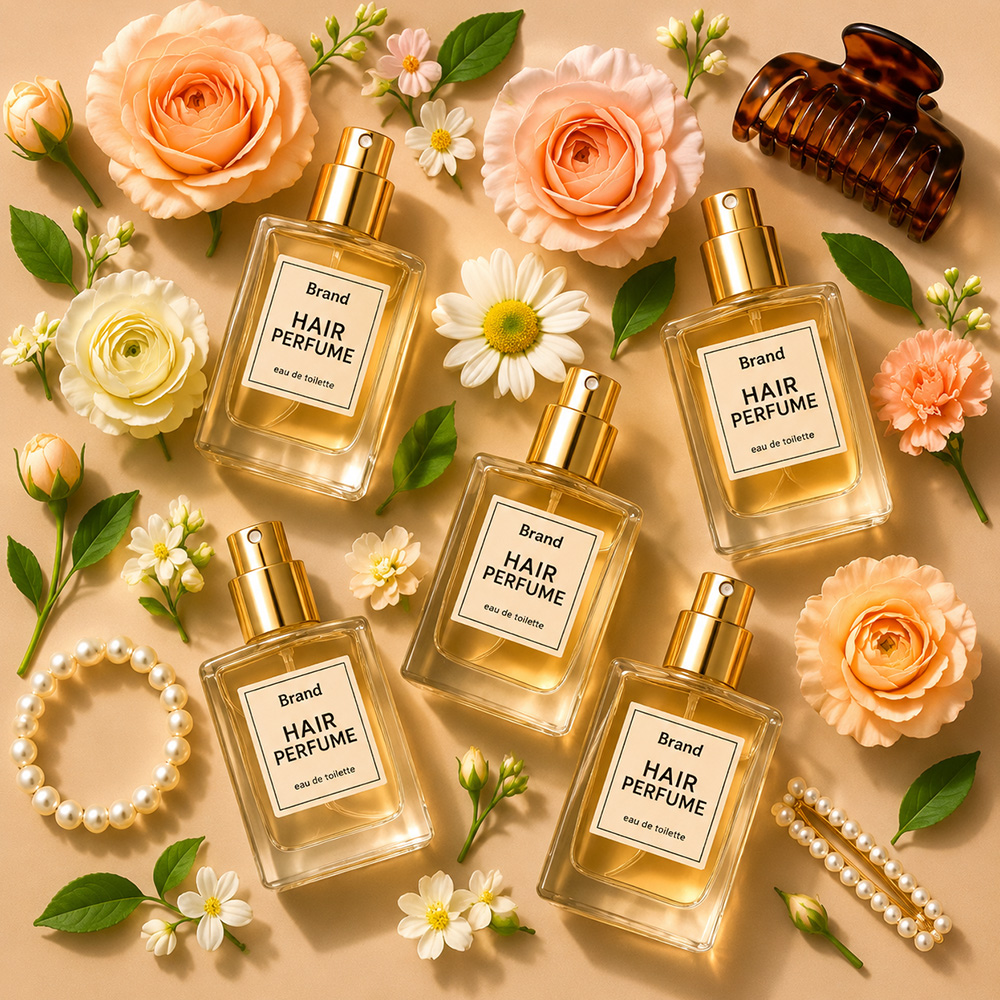
Different hair fragrance product formats offer brands opportunities to create distinctive signature scent collections.
3. Hair Perfume Product Opportunities for Private Label Brands
Developing a signature hair fragrance line allows brands to introduce a specialized product category while building on their existing hair care collections.
Premium Hair Fragrance Collection
A premium collection can focus on distinctive fragrance profiles, refined packaging, and a memorable application experience. Brands may explore floral, woody, amber, musk, and other fragrance directions.
Everyday Hair Mist Collection
Everyday hair mists can focus on convenient application, refreshing fragrance, and lightweight product feel.
Salon Signature Fragrance Collection
Salons can develop signature hair fragrance products that complement their professional services and reinforce a recognizable salon identity.
Luxury Hair Oil and Fragrance Collection
Scented hair oils can combine a distinctive fragrance with selected emollients and conditioning ingredients to create a premium finishing product.
Coordinated Hair Care Fragrance Collection
Brands can extend a recognizable fragrance profile across shampoos, conditioners, masks, oils, serums, and hair mists. This creates a more consistent sensory experience across the product range.
Explore HODM Signature Fragrance Development to explore fragrance directions for your collection.
4. How to Develop a Signature Hair Fragrance for Your Brand
A signature fragrance should reflect the brand's personality, target customers, product positioning, and intended sensory experience.
Define Your Brand Fragrance Identity
Before selecting individual fragrance notes, determine how you want customers to perceive your brand.
- Fresh and Clean: Suitable for brands emphasizing freshness and everyday care.
- Floral and Elegant: Appropriate for feminine, premium, and salon-oriented collections.
- Warm and Sophisticated: Suitable for luxury and fragrance-focused product ranges.
- Herbal and Botanical: Can support nature-inspired and wellness-oriented positioning.
- Fruity and Playful: Suitable for youthful and vibrant product concepts.
Explore Fragrance Families
Different fragrance families provide different sensory directions. Brands can evaluate individual scent profiles or combine complementary fragrance notes to create a more distinctive identity.
Develop a Recognizable Signature Scent
A signature scent does not need to be complicated. A carefully balanced fragrance profile with a recognizable character can help establish brand consistency.
Evaluate Fragrance Samples
Review fragrance samples for initial scent impression, development over time, overall intensity, and compatibility with the intended formula.
Confirm the Final Fragrance Direction
Once the preferred scent has been selected, document the fragrance reference and relevant specifications for future formula development and production.
5. Popular Fragrance Families for Hair Perfume Products
Fragrance selection is one of the most important decisions when developing hair perfume products. The scent should match the brand identity and remain suitable for the intended product application.
Fresh and Citrus Fragrances
Citrus-inspired profiles may include lemon, bergamot, grapefruit, and orange. They create a bright and refreshing scent direction suitable for everyday hair fragrance products.
Floral and Botanical Fragrances
Rose, jasmine, lavender, and peony can create soft, elegant, and refined fragrance profiles.
Fruity and Sweet Fragrances
Peach, apple, berries, and other fruity notes can create vibrant and approachable fragrance concepts.
Herbal and Green Fragrances
Rosemary, mint, green tea, and other botanical-inspired notes can provide a fresh and clean sensory direction.
Warm, Creamy, and Woody Fragrances
Vanilla, coconut, amber, sandalwood, and musk can support warmer and more sophisticated fragrance concepts.
Compare Fragrance Families
| Fragrance Family | Example Notes | Brand Positioning |
|---|---|---|
| Fresh & Citrus | Lemon, Bergamot, Grapefruit | Clean and Refreshing |
| Floral & Botanical | Rose, Jasmine, Lavender | Elegant and Refined |
| Fruity & Sweet | Peach, Apple, Berries | Playful and Vibrant |
| Herbal & Green | Mint, Rosemary, Green Tea | Fresh and Botanical |
| Warm & Creamy | Vanilla, Coconut, Tonka | Comforting and Premium |
| Woody & Musky | Sandalwood, Cedar, Musk | Modern and Sophisticated |
HODM offers fragrance customization directions including fresh citrus, floral, fruity, herbal, warm and creamy, and personalized signature fragrance concepts.
Explore Custom Hair Care Fragrance & Sensory Solutions to discuss your preferred scent family.
6. Hair Perfume Formulation: Key Ingredients and Formula Systems
Hair perfume formulation requires a suitable balance between fragrance delivery, formula stability, application feel, and compatibility with the intended packaging.
Fragrance Ingredients
Fragrance compositions create the product's scent character. Their selection depends on the desired fragrance family, intensity, formula base, and applicable safety requirements.
Alcohol-Based Formula Systems
Some hair perfume sprays use alcohol-based systems to support fragrance solubilization, quick drying, and a lightweight application experience.
The alcohol type and concentration should be selected according to the formula, intended use, target market, and product safety requirements.
Water-Based Formula Systems
Water-based hair mists can be developed for brands seeking alternative product concepts. Fragrance solubilization and formula clarity may require suitable solubilizers or other formulation approaches.
Solubilizers
Fragrance oils may not be naturally compatible with water-based systems. Suitable solubilizers can help incorporate fragrance into certain formulations, depending on the fragrance composition and overall formula.
Conditioning Ingredients
Multifunctional hair fragrance products may include selected conditioning ingredients to support smoothness, manageability, or a more comfortable after-use feel.
Humectants and Supporting Ingredients
Depending on the product concept, formulators may consider ingredients such as Glycerin, Panthenol, and other suitable supporting materials. Their inclusion should be balanced against clarity, residue, drying behavior, and compatibility.
Formula Selection by Product Type
| Formula Component | Potential Function | Product Application |
|---|---|---|
| Fragrance Composition | Signature scent | All fragrance products |
| Alcohol-Based Carrier | Fragrance delivery and drying | Selected perfume sprays |
| Water-Based System | Lightweight formula base | Selected hair mists |
| Solubilizer | Fragrance compatibility | Selected water-based mists |
| Conditioning Agents | Hair feel and manageability | Multifunctional hair mists |
| Emollients | Softness and conditioning | Hair fragrance oils |
No single formula system is suitable for every hair perfume product. Ingredient selection and concentration should be determined through formulation development, compatibility testing, and applicable safety assessments.
7. How to Improve Fragrance Longevity in Hair Perfume Products
Fragrance longevity is an important consideration when developing hair perfume products. Customers may expect the scent to remain pleasant after application without becoming overpowering or changing unpleasantly over time.
Choose Suitable Fragrance Compositions
Fragrance compositions contain different volatile materials that evaporate at different rates. The balance of top, middle, and base notes influences how the scent develops after application.
Understand Top, Middle, and Base Notes
- Top Notes: Create the initial fragrance impression after application.
- Middle Notes: Form the central character of the fragrance.
- Base Notes: Contribute to the deeper and longer-developing scent profile.
Evaluate Fragrance in the Finished Formula
A fragrance may smell different in its original concentrate compared with the finished hair mist or oil. The formula base, fragrance concentration, and other ingredients can influence the final scent experience.
Consider Hair Application Conditions
Hair type, application quantity, environmental conditions, and product usage can influence perceived fragrance longevity.
Test Fragrance Over Time
Evaluate the initial scent, the fragrance after drying, and the scent after a defined period. Use consistent application quantities and testing conditions to compare different samples.
Avoid Unsupported Long-Lasting Claims
If a brand wants to claim that a hair fragrance lasts for a specific number of hours, the claim should be supported by appropriate testing using the finished product.
8. Formula Compatibility and Hair Feel in Fragrance Products
A successful hair fragrance product should provide the desired scent experience while maintaining suitable formula characteristics and a comfortable application feel.
Fragrance Solubility
Fragrance ingredients may behave differently in alcohol-based, water-based, and oil-based systems. Formula clarity, separation, and stability should be evaluated using the actual fragrance composition.
Formula Clarity
Some hair mists are expected to have a clear appearance. If the formula becomes cloudy or separates after fragrance addition, the formulation system may require adjustment.
Drying Time
Hair fragrance sprays should be evaluated for drying behavior and the finished hair feel. Excessive wetness or an undesirable sticky finish may affect the user experience.
Residue and Build-Up
The formula should be assessed for visible residue, excessive coating, or an unwanted heavy feel after application.
Hair Conditioning Compatibility
If the product includes conditioning ingredients, evaluate whether the combination of fragrance and conditioning components remains stable and performs as intended.
Compatibility with Other Products
Brands developing a coordinated fragrance collection should consider how the hair mist, shampoo, conditioner, and styling products work together. Their fragrance profiles should complement one another without creating an overly strong combined scent.
9. Packaging Options for Private Label Hair Perfume Products
Packaging influences the application experience, fragrance preservation, brand presentation, and product convenience.
Fine Mist Spray Bottles
Fine mist spray bottles are suitable for many hair fragrance products. They can provide convenient application across the hair lengths and help distribute the formula more evenly.
Premium Glass Spray Bottles
Glass packaging can support a premium fragrance positioning. However, weight, breakage protection, closure compatibility, and transportation requirements should be considered.
Lightweight Plastic Spray Bottles
Suitable plastic containers may offer convenient handling and flexibility for different capacities. Material compatibility should be evaluated with the actual formula.
Dropper and Pump Bottles
Hair fragrance oils may use dropper or pump packaging depending on the desired dispensing method and formula viscosity.
Packaging Design Considerations
- Container material and capacity.
- Fine mist distribution.
- Spray output and consistency.
- Closure and leakage resistance.
- Formula and material compatibility.
- Light protection where required.
- Labeling and brand decoration.
- Transportation and storage conditions.
Compare Hair Fragrance Packaging
| Packaging Format | Suitable Product | Key Consideration |
|---|---|---|
| Fine Mist Bottle | Hair Mist | Spray distribution |
| Glass Spray Bottle | Premium Hair Perfume | Breakage and compatibility |
| Plastic Spray Bottle | Everyday Hair Fragrance | Material compatibility |
| Dropper Bottle | Hair Fragrance Oil | Controlled application |
| Pump Bottle | Scented Hair Oil | Formula viscosity and output |
Explore HODM Custom Packaging Solutions to discuss bottles, spray pumps, closures, and product decoration.
10. Hair Perfume Testing: Stability, Fragrance, and Spray Performance
Before commercial production, hair perfume products should undergo suitable testing to confirm that the fragrance, formula, and packaging meet the agreed product specifications.
Fragrance Evaluation
- Initial fragrance impression.
- Scent character after drying.
- Fragrance intensity.
- Fragrance development over time.
- Consistency between samples.
Formula Stability Testing
Evaluate changes in appearance, color, odor, clarity, and other relevant formula characteristics under appropriate storage conditions.
Spray Performance Testing
For spray products, assess mist distribution, output consistency, nozzle performance, repeated dispensing, and ease of application.
Packaging Compatibility Testing
Evaluate the actual formula with the selected bottle, pump, closure, and other packaging components. Check for leakage, material interaction, and dispensing problems.
Hair Feel and Application Testing
Test the finished product on representative hair types to evaluate drying time, residue, softness, and overall application experience.
Microbiological and Safety Assessment
Water-based hair mists require appropriate preservation and microbiological quality assessments. Alcohol-based and oil-based products also require safety and stability evaluation according to their composition and intended use.
For more information about product testing and approval, read Hair Care Product Sample Evaluation: What Brands Should Check Before Approval.
11. How to Build a Complete Signature Hair Fragrance Product Line
A signature fragrance can be extended across different hair care categories to create a coordinated product collection.
Start with a Hero Hair Fragrance Product
Brands can begin with one signature hair mist or hair perfume spray that establishes the main fragrance identity.
Extend the Fragrance into Hair Care Products
- Signature fragrance shampoo.
- Matching conditioner.
- Scented hair mask.
- Hair fragrance mist.
- Hair oil and serum.
- Leave-in conditioning spray.
Develop Complementary Fragrance Variations
Brands may choose one recognizable signature scent or create several related fragrances for different customer preferences.
Maintain Fragrance Consistency Across Products
A shared fragrance direction can strengthen product recognition. However, the same fragrance concentrate may perform differently in shampoo, conditioner, oil, and spray formulas.
Each finished product should therefore undergo its own compatibility and sensory evaluation.
Use Packaging to Reinforce Brand Identity
Coordinated bottle shapes, colors, labels, and finishes can help create a recognizable fragrance collection across different product formats.
12. Custom Formulation for Private Label Hair Perfume Products
Private label brands can customize hair perfume products according to their target customers, fragrance preferences, product formats, and commercial positioning.
Prepare a Product Development Brief
- Product format: hair mist, perfume spray, or fragrance oil.
- Target customer and market.
- Preferred fragrance family.
- Desired scent intensity and character.
- Alcohol-based or alternative formula preference.
- Conditioning or multifunctional requirements.
- Desired drying feel and residue level.
- Packaging type and product capacity.
- Target cost and expected MOQ.
- Applicable product claims and labeling requirements.
Select a Fragrance Direction
Choose a fragrance profile that reflects your brand identity and target customers. Reference fragrances, scent samples, and brand moodboards can help communicate your preferences.
Develop and Evaluate Formula Samples
Review fragrance character, formula appearance, drying behavior, hair feel, and packaging compatibility using actual product samples.
Refine and Approve the Final Product
Record the approved fragrance direction, formula version, packaging specifications, and other relevant product requirements before commercial manufacturing.
Explore HODM Custom Hair Care Fragrance & Sensory Solutions to discuss your signature fragrance concept.
13. Hair Perfume Manufacturing Process: From Fragrance Concept to Finished Product
Hair perfume manufacturing involves coordination between fragrance selection, formula development, packaging, sample evaluation, production, and finished product inspection.
Step 1: Product Consultation
Define the product format, target customers, fragrance direction, application requirements, and brand positioning.
Step 2: Fragrance Selection
Explore suitable fragrance families and identify scent profiles that match the brand's identity.
Step 3: Formula Development
Develop a suitable formula base and evaluate fragrance compatibility, clarity, drying behavior, and desired hair feel.
Step 4: Sample Preparation and Evaluation
Prepare samples and assess fragrance character, intensity, application, spray performance, and other relevant product requirements.
Step 5: Packaging Selection
Select appropriate spray bottles, fine mist pumps, closures, and other packaging components.
Step 6: Formula and Packaging Approval
Confirm the approved formula, fragrance, packaging specifications, and applicable quality requirements.
Step 7: Commercial Production
Proceed with raw material preparation, liquid manufacturing, filling, packaging, and batch documentation according to the approved specifications.
Step 8: Quality Inspection and Shipment
Inspect fragrance consistency, formula appearance, filling accuracy, spray performance, and packaging condition before finished products are released for shipment.
Explore HODM Hair Mist Manufacturing to learn more about the hair mist development process.
14. Choosing a Hair Perfume Manufacturer for Your Brand
Selecting the right hair perfume manufacturer is important for developing a distinctive fragrance product with suitable formula performance and packaging.
Evaluate Fragrance Development Capabilities
Review the manufacturer's ability to explore different fragrance families, develop signature scent directions, prepare samples, and refine fragrance profiles.
Review Formula Development Experience
Ask about alcohol-based and water-based hair mist systems, fragrance solubilization, formula compatibility, drying behavior, and conditioning options.
Check Spray and Packaging Capabilities
Confirm available spray bottles, fine mist pumps, closures, decoration methods, and compatibility testing arrangements.
Understand MOQ and Lead Time
Review minimum quantities, fragrance customization requirements, packaging procurement, sample development, production scheduling, and shipping arrangements.
Review Quality Management
Consider formula stability, fragrance consistency, packaging compatibility, finished product inspection, and relevant quality documentation.
Evaluate the Complete Development Process
A suitable manufacturing partner should be able to coordinate fragrance selection, sample evaluation, formula development, packaging preparation, and commercial production according to the project's requirements.
Explore HODM Hair Mist Manufacturer Solutions for more information.
15. Common Mistakes When Developing Hair Perfume Products
Using a Fragrance Without Formula Compatibility Testing
A fragrance that smells attractive in its concentrate may not perform the same way in the finished hair mist or oil. Compatibility and stability should be evaluated using the complete formula.
Focusing Only on Initial Fragrance
The first impression does not represent the complete fragrance experience. Brands should evaluate how the scent develops after application and drying.
Creating an Overpowering Fragrance
Excessively strong fragrance may not suit everyday hair application. Fragrance intensity should match the product's purpose and target customers.
Ignoring Hair Feel and Residue
A fragrance product should not create an undesirable heavy, sticky, or coated finish. Formula performance and sensory characteristics should be evaluated together.
Choosing Packaging Based Only on Appearance
A beautiful bottle is not enough. Spray distribution, closure performance, material compatibility, and leakage resistance must also be considered.
Using Identical Fragrance Concentrations Across Every Product
Different formula bases may require different fragrance levels and solubilization approaches. Each product should be evaluated independently.
Making Unsupported Long-Lasting Claims
Claims about fragrance duration, conditioning benefits, or hair protection should be supported by suitable evidence from the finished product.
Frequently Asked Questions
What are hair perfume products?
Hair perfume products are fragrance-focused products developed for application to the hair. Common formats include hair mists, fragrance sprays, scented hair oils, and selected leave-in treatments.
What is the difference between hair perfume and regular perfume?
Traditional perfumes are primarily designed for skin application, while hair perfume products are developed with hair application, hair feel, formula compatibility, and suitable dispensing systems in mind. Brands should follow the intended use and safety instructions of each product.
What is the difference between hair mist and hair perfume?
Hair mist is generally positioned as a lightweight spray product that may combine fragrance with refreshing or conditioning functions. Hair perfume usually places greater emphasis on the fragrance experience. The actual distinction depends on the formula and product positioning.
What fragrance types are popular for hair perfume products?
Common fragrance directions include fresh citrus, floral, fruity, herbal, warm creamy, woody, and musky profiles. The best choice depends on the brand identity and target customers.
Can hair perfume be developed without alcohol?
Yes. Selected water-based or other alternative formula systems can be explored. However, fragrance solubility, clarity, stability, preservation, and drying behavior must be evaluated according to the complete formulation.
How can brands develop a long-lasting hair fragrance?
Fragrance composition, formula base, concentration, application quantity, and hair characteristics can all influence perceived scent longevity. The finished product should be evaluated over time under consistent conditions before making duration claims.
Can the same signature fragrance be used across different hair care products?
Yes. Brands can develop a coordinated fragrance direction across shampoos, conditioners, masks, hair oils, and mists. However, each formula requires individual compatibility and sensory evaluation because the same fragrance may behave differently in different product bases.
What packaging is suitable for private label hair perfume?
Fine mist spray bottles, glass spray bottles, suitable plastic containers, and pump or dropper bottles can be considered depending on the formula. Packaging should be evaluated for spray performance, compatibility, leakage, and product presentation.
Can HODM develop a custom signature hair fragrance?
HODM offers fragrance customization support for private label hair care products. Brands can discuss scent families, signature fragrance directions, sample evaluation, and formula compatibility according to their project requirements.
Can HODM manufacture private label hair mists?
HODM provides hair mist formulation and manufacturing support, including fragrance customization, spray performance evaluation, packaging coordination, and quality inspection.
Conclusion: Develop a Signature Hair Fragrance Line for Your Brand
Hair perfume products offer brands an opportunity to expand beyond traditional hair care categories and create more distinctive sensory experiences.
Hair mists, fragrance sprays, scented hair oils, and leave-in treatments can each provide different product experiences and commercial opportunities.
Successful development requires careful fragrance selection, formula compatibility, scent evaluation, suitable packaging, and finished product testing. A signature fragrance should complement the hair care formula rather than simply being added as a final decorative ingredient.
By combining a recognizable scent identity with appropriate product formats and manufacturing support, brands can develop a coordinated hair fragrance collection that strengthens product differentiation and customer recognition.
Create Your Signature Hair Fragrance Line with HODM
HODM Cosmetics supports private label brands, salons, and distributors with custom hair fragrance development, hair mist formulation, fragrance customization, packaging solutions, and OEM/ODM manufacturing.
From fresh citrus and floral fragrances to warm, creamy, and personalized signature scents, our team can help explore suitable fragrance directions for your hair care collection.
Share your preferred scent profile, product formats, target customers, and packaging ideas to discuss your hair fragrance development project.
Start Your Signature Fragrance Project