Best Low-MOQ Hair Care Manufacturers for Startups in 2027
Launching a hair care brand can be exciting, but finding the right manufacturer is often one of the biggest challenges for startups.
Many new brands want to introduce professional shampoos, conditioners, hair oils, or scalp treatments without committing to thousands of units before knowing how their products will perform.
This is where low-MOQ hair care manufacturers can make a difference.
By offering smaller production quantities, flexible private label programs, and selected customization options, these manufacturers can help emerging brands enter the market with more manageable inventory commitments.
However, not every manufacturer defines “low MOQ” the same way. Some offer ready-made formulas starting at fewer than 100 units, while others require several hundred units or measure their minimums in gallons or kilograms.
The right choice depends on your product concept, available budget, customization requirements, target market, and plans for future growth.
In this guide, we compare seven hair care manufacturing options for startups, explain their publicly available minimum order requirements, and explore how to choose a manufacturing partner that fits your business.
What Is a Low-MOQ Hair Care Manufacturer?
MOQ stands for Minimum Order Quantity, the smallest quantity a manufacturer is willing to produce or supply under a particular program.
A low-MOQ hair care manufacturer offers relatively small order quantities compared with traditional large-volume contract manufacturing.
This can be particularly useful for entrepreneurs launching their first products, salon owners developing retail collections, and ecommerce businesses testing new product concepts.
What Counts as a Low MOQ?
There is no universal minimum that qualifies a hair care manufacturer as low MOQ.
Requirements vary depending on the product, formula, packaging, manufacturing process, and supplier.
For example, manufacturers may offer:
- Fewer than 100 units for selected ready-made products.
- 100–500 units for certain private label or semi-custom programs.
- 500–1,000 units for more involved production and packaging projects.
- Higher minimums for fully customized formulas or specialized manufacturing.
These are illustrative categories, not standardized industry thresholds.
A manufacturer offering 500 units per SKU may still be a practical low-MOQ option for a startup that needs a customized shampoo and conditioner line.
Why MOQ Matters for Startups
Minimum order quantities directly influence the amount of money a new brand must invest before launching.
Lower minimums may help businesses reduce initial inventory commitments, test product demand, introduce new categories, and preserve working capital for marketing and customer acquisition.
However, smaller orders often carry higher unit costs.
The goal should not simply be finding the lowest MOQ. It should be finding the most suitable balance between order quantity, product quality, customization, pricing, and long-term manufacturing reliability.
Quick Comparison: Best Low-MOQ Hair Care Manufacturers
The following manufacturers offer different entry points for startups and emerging hair care brands.
| Manufacturer | Location | Publicly Stated Minimum | Best For |
|---|---|---|---|
| HODM Cosmetics | China | Finished hair care products from 500 units per item on its custom formula service page; project-dependent | Flexible OEM/ODM development |
| Pravada Private Label | USA | 50 units per SKU for private label | Small private label launches |
| DLAB Custom Cosmetics | Portugal | 100 units per SKU for online customization | Online product customization |
| Brandology Labs | Location to confirm | 72 units per SKU for hair care | Small branded collections |
| RainShadow Labs | USA | No minimum for Buy Direct; stock filling from 10 gallons | Bulk and stock-formula flexibility |
| Bonnet Cosmetic | USA | 500 units per SKU for most stock formulas | U.S.-based professional hair care |
| LissCréation | France / Europe | From 200 units per reference on its main site | Professional salon treatments |
Important: These minimums refer to different manufacturing programs and are not directly interchangeable. Confirm current product eligibility, packaging requirements, and quotation terms with each supplier.
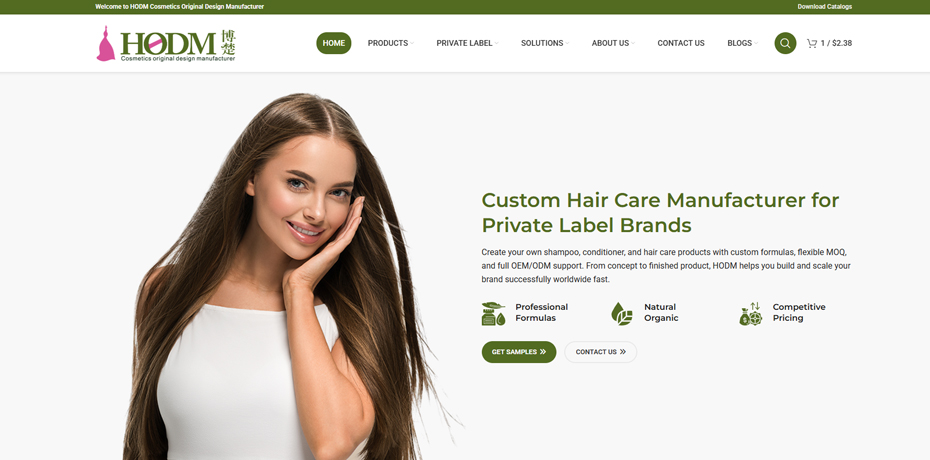
1. HODM Cosmetics – Best for Flexible OEM/ODM Hair Care Development
Location: China
Best for: Startups and growing brands seeking private label hair care, formula customization, packaging development, and scalable manufacturing support.
MOQ: HODM publishes a starting point of 500 pieces per item for full-service finished hair care products on its custom formula service page. Actual minimums depend on the product and packaging requirements.
Official website: https://www.hairodm.com
- HODM Cosmetics is a hair care manufacturing partner offering OEM/ODM and private label development services for beauty brands, entrepreneurs, salons, and distributors.
- Its product portfolio includes shampoos, conditioners, hair masks, hair oils, and other hair treatment products designed for different consumer needs.
- For startups, HODM provides access to established product concepts alongside options for formula, fragrance, packaging, and branding customization.
- This flexibility can help businesses begin with a focused collection and gradually expand their product range as demand develops.
Why Startups May Choose HODM
One advantage of working with HODM is the combination of product development and manufacturing services.
Instead of coordinating separately with formula developers, packaging suppliers, and filling facilities, brands can discuss multiple development requirements with one manufacturing partner.
HODM also offers a dedicated low-MOQ solutions program for emerging businesses.
Brands can explore different product categories, evaluate samples, choose packaging options, and develop a production plan based on their intended market.
For businesses planning to move beyond basic private labeling, access to formula customization can also support future differentiation.
Best suited for: Emerging hair care brands, ecommerce businesses, salon brands, and entrepreneurs seeking an OEM/ODM manufacturing partner in China.
Things to consider: Confirm the MOQ for each SKU, particularly when requesting custom formulas, specialized bottles, printed packaging, or multiple fragrances. International shipping, import requirements, and delivery costs should also be included in the project budget.
Learn more: HODM Low-MOQ Hair Care Solutions
2. Pravada Private Label – Best for Very Small Private Label Launches
Location: Florida, USA
Best for: Entrepreneurs, salon owners, and emerging beauty brands seeking ready-to-brand hair care products with low initial order quantities.
MOQ: From 50 units per SKU for private label products, 250 units for semi-custom products, and 2,500 units for custom formulation projects.
Official website: https://www.pravadaprivatelabel.com
- Pravada Private Label offers U.S.-based private label manufacturing services across hair care, skincare, and other personal care categories.
- Its hair care portfolio includes shampoos, conditioners, hair masks, leave-in treatments, styling products, hair oils, and scalp care products.
- For new brands, Pravada’s established formula collection provides a way to launch products without immediately investing in fully customized research and development.
- Businesses can select suitable formulas, explore fragrance and packaging options, and create branded products for their intended customers.
Why Startups May Choose Pravada
Pravada’s low starting MOQ is particularly relevant for businesses that want to validate demand before purchasing large quantities.
Its manufacturing programs also provide a potential development path from standard private label products to semi-custom and fully custom formulations.
This makes it possible for a brand to begin with an existing product concept and explore greater differentiation as sales increase.
Best suited for: Small beauty startups, independent salons, online retailers, and brands testing their first hair care products.
Things to consider: The 50-unit minimum applies to the private label program, not every customization option. Brands requesting substantial ingredient changes or exclusive formulas should evaluate the higher minimums associated with those services.

3. DLAB Custom Cosmetics – Best for Online Hair Care Customization
Location: Porto, Portugal
Best for: Startups seeking a digital product customization process and relatively small initial manufacturing orders.
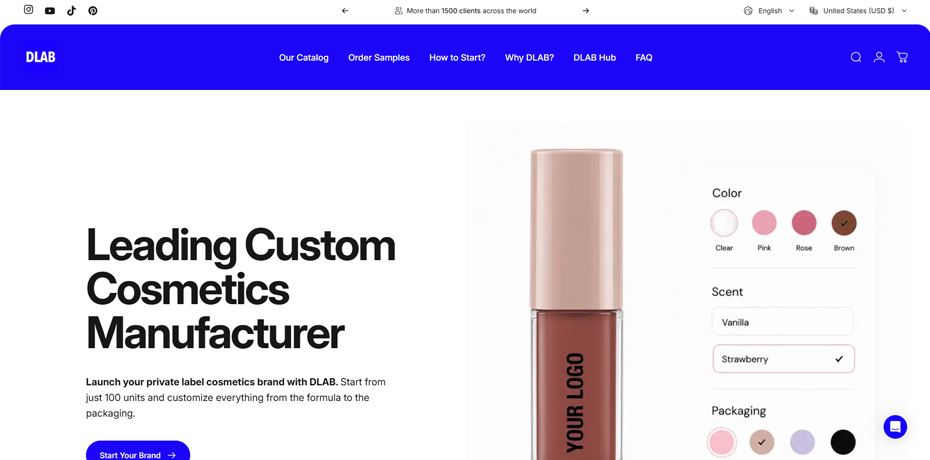
MOQ: From 100 units per SKU for online customization and 500 units for advanced customization.
Official website: https://dlabcosmetics.com
- DLAB Custom Cosmetics offers private label manufacturing across hair care, skincare, body care, and other cosmetic categories.
- Its hair care selection includes products such as shampoo, hair oil, leave-in conditioner, and hair masks.
- A distinguishing feature of DLAB is its online customization approach, allowing businesses to configure selected product characteristics through its website.
- Depending on the product and program, customization options may include fragrance, ingredients, packaging, and branding.
Why Startups May Choose DLAB
DLAB may appeal to entrepreneurs who want a structured process for selecting and customizing products.
Its online model can help simplify early product planning by presenting available customization choices before a larger manufacturing commitment.
The company also provides advanced customization services for projects requiring greater flexibility.
For startups operating in European markets, its European manufacturing location may also be relevant when evaluating logistics and regulatory documentation.
Best suited for: Digital-first beauty brands, European startups, small ecommerce businesses, and entrepreneurs seeking customizable products.
Things to consider: Online customization and advanced custom formulation have different minimums and development requirements. Confirm which options are available for the exact hair care product you intend to launch.
4. Brandology Labs – Best for Small Branded Hair Care Collections
Location: Confirm manufacturing location directly with the supplier.
Best for: Startups looking to launch a compact hair care range with small per-SKU minimums.
MOQ: From 72 units per SKU for hair care, according to the company’s website.
Official website: https://brandologylabs.com
- Brandology Labs presents itself as a private label manufacturer and formulation laboratory serving modern beauty and wellness brands.
- Its product offering includes hair care categories such as shampoos, conditioners, serums, and styling products.
- The company emphasizes small order quantities, brand presentation, and accessible product development for emerging businesses.
Why Startups May Choose Brandology Labs
A 72-unit starting quantity may be attractive to businesses that want to introduce a small branded collection without holding substantial inventory.
This could be useful for salon retail programs, niche beauty brands, or businesses experimenting with a new product category.
Its combination of private label manufacturing and brand-focused services may also appeal to entrepreneurs seeking support beyond product filling alone.
Best suited for: Small salon collections, boutique beauty brands, and entrepreneurs testing limited product ranges.
Things to consider: Confirm the available hair care formulas, customization restrictions, manufacturing location, and whether the published minimum applies to the specific products and packaging you need.
5. RainShadow Labs – Best for Flexible Bulk and Stock-Formula Purchasing
Location: USA
Best for: Brands seeking ready-developed hair care formulas, bulk purchasing options, or flexible filling arrangements.
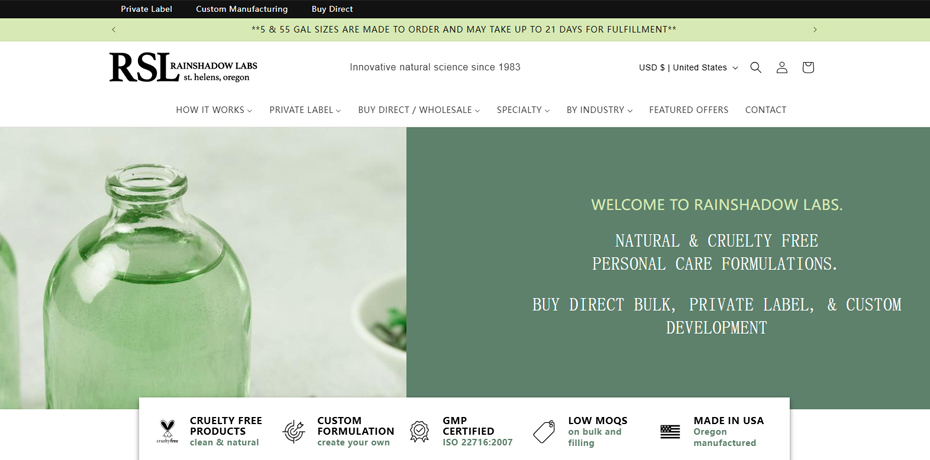
MOQ: No minimum for its Buy Direct program; stock filling begins at 10 gallons, and custom formulas begin at 25 gallons.
Official website: https://www.rainshadowlabs.com
- RainShadow Labs provides private label and custom manufacturing services across several personal care categories, including hair care.
- Its hair care offerings include shampoos, conditioners, oils, scalp treatments, and styling products.
- The company provides access to an established stock-formula portfolio, giving brands an alternative to developing every product from the beginning.
Why Startups May Choose RainShadow Labs
RainShadow Labs is particularly relevant for businesses that want flexibility in how they purchase products.
Its Buy Direct program and volume-based filling options may suit different stages of brand development.
For some entrepreneurs, purchasing stock products or bulk formulas can be a practical way to evaluate a product concept before moving into more customized production.
The company also provides a path toward larger or more specialized projects.
Best suited for: Natural-positioned hair care brands, salons, small retailers, and businesses interested in bulk or stock-formula purchasing.
Things to consider: A no-minimum Buy Direct program is not equivalent to no-minimum custom bottled manufacturing. Confirm whether your project requires bulk product, filling, labeling, or complete finished goods, and calculate the finished-unit equivalent before comparing quotations.
6. Bonnet Cosmetic – Best for U.S.-Based Professional Hair Care Manufacturing
Location: USA
Best for: Emerging and growing brands seeking professional hair care products manufactured in the United States.
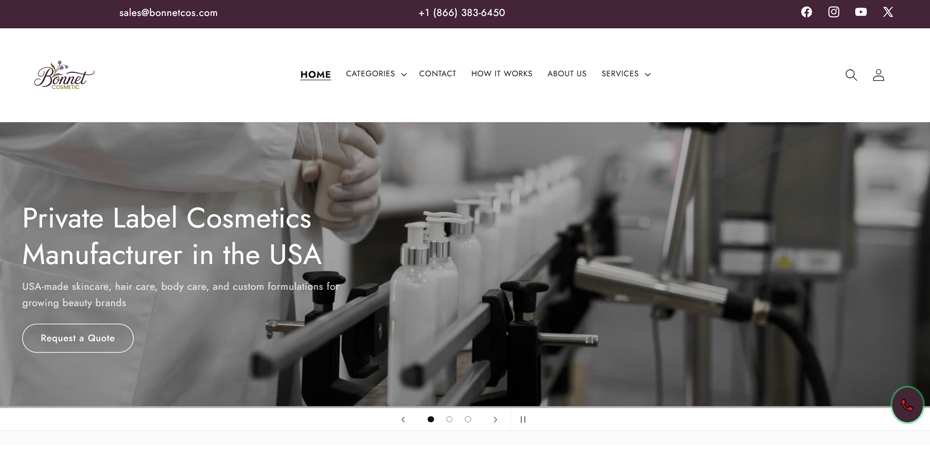
MOQ: From 500 units per SKU for most stock hair care formulas.
Official website: https://privatelabelcosmetic.com
- Bonnet Cosmetic offers private label hair care manufacturing services covering shampoos, conditioners, hair treatments, styling products, and other professional formulas.
- Its manufacturing services include product selection, sampling, filling, labeling, and packaging support.
- The company offers ready-to-market formulas designed for different hair care concepts, including moisturizing, volumizing, clarifying, and color-care products.
Why Startups May Choose Bonnet Cosmetic
Bonnet Cosmetic may suit brands that want U.S.-based manufacturing while maintaining a relatively focused initial product range.
Its established hair care formulas can reduce the need for extensive formulation development during the first launch.
For salon-oriented brands, the availability of professional hair care categories may also support coordinated product collections.
Best suited for: U.S. beauty startups, salon brands, professional hair care retailers, and businesses introducing established formula concepts.
Things to consider: Its 500-unit starting MOQ is higher than some other private label programs in this guide. Confirm packaging availability, formula selection, pricing, and the minimum quantity for each planned SKU.
7. LissCréation – Best for Professional Salon Treatment Brands
Location: France / Europe
Best for: Entrepreneurs and salon brands developing professional smoothing and treatment-focused hair care collections.
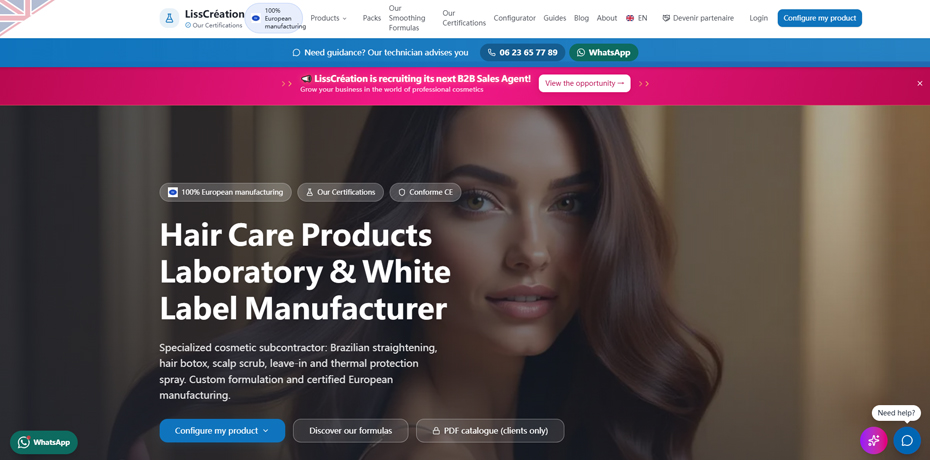
MOQ: The company’s main website states a starting minimum of 200 units per reference, although another page advertises smaller minimums for selected white-label offerings. Confirm the current requirement for your chosen product.
Official website: https://lisscreation.com/en
- LissCréation is a European hair care manufacturer focused on professional hair cosmetics.
- Its product range includes smoothing treatments, shampoos, conditioners, masks, serums, leave-in care, and other specialized salon products.
- Unlike manufacturers offering a broad range of general beauty products, LissCréation emphasizes professional hair treatment applications.
- This specialization may appeal to businesses targeting salons, hair professionals, and premium treatment-oriented customers.
Why Startups May Choose LissCréation
For brands entering the professional salon market, access to specialized treatment formulas can be an important consideration.
LissCréation offers private label options and product customization services, including branding and packaging.
Its European manufacturing base may also be relevant for businesses prioritizing European sourcing and documentation.
Best suited for: Salon entrepreneurs, professional treatment brands, and businesses targeting European hair care markets.
Things to consider: Confirm the minimum order quantity for each formula and distinguish between standard white-label products and more customized development. Specialized salon products may require additional attention to professional-use instructions, safety assessments, and regulatory compliance.
How We Selected These Low-MOQ Hair Care Manufacturers
This comparison focuses on manufacturers that publicly describe hair care manufacturing services and offer a small-order, stock-formula, or flexible production program.
The main evaluation factors include:
- Publicly available minimum order information.
- Availability of hair care product categories.
- Private label or customization capabilities.
- Suitability for emerging brands.
- Packaging and manufacturing support.
- Potential to accommodate future business growth.
Disclosure: This guide is published by HODM Cosmetics, which is included among the manufacturers discussed. Other manufacturers are presented for comparison, and inclusion does not imply a commercial partnership or independent product endorsement.
The manufacturers are not ranked by independently tested product quality. Minimum order information should be reconfirmed directly before making purchasing decisions.
Private Label vs Custom Hair Care Manufacturing: Which Is Better for Startups?
One of the first decisions a new hair care brand must make is whether to begin with an existing formula or invest in custom formulation.
Both approaches can work, but their costs, development requirements, and minimum order quantities are often different.
Private Label Hair Care
Private label manufacturing typically allows a business to select an established formula and sell it under its own brand.
The manufacturer may provide options for labeling, fragrance, packaging, or limited personalization.
Because the core formula already exists, development requirements can be lower than those associated with creating a completely new product.
For startups, this can reduce technical complexity and support a more straightforward launch process.
However, the formula may also be available to other brands.
Custom Hair Care Formulation
Custom formulation involves developing a product around a specific brand brief.
This may include ingredient selection, performance requirements, texture development, fragrance, and compatibility testing.
Custom development can offer greater product differentiation, but it often requires additional investment, longer development periods, and higher minimum quantities.
For brands with a distinctive product concept and sufficient capital, custom manufacturing may provide a stronger foundation for long-term product positioning.
Which Option Should a New Brand Choose?
Private label is often a practical starting point for brands that want to test demand, establish their identity, and learn from customer feedback.
Custom formulation may be more suitable when product differentiation is central to the business strategy.
Some manufacturers also offer semi-custom programs, which can provide a middle ground between standard private label and fully custom development.
How Much Does Low-MOQ Hair Care Manufacturing Cost?
A low MOQ can reduce the number of products a startup must purchase, but it does not automatically guarantee a low total launch cost.
Brands should evaluate the complete project budget rather than comparing manufacturing quantities alone.
Product Manufacturing Costs
Manufacturing costs depend on formula ingredients, product size, production volume, processing requirements, and packaging.
For example, a 250 ml shampoo and a concentrated scalp serum may have very different costs even when ordered in identical quantities.
Packaging and Labeling
Bottles, caps, pumps, droppers, labels, and outer cartons can all affect the final quotation.
Specialized packaging may have minimum purchase requirements that exceed the manufacturer’s formula MOQ.
Standard packaging can sometimes help startups reduce complexity during an initial launch.
Sampling and Formula Development
Some manufacturers charge for samples, formula modifications, or custom research and development.
Brands should confirm whether sampling fees are refundable, whether revisions are included, and what happens if the project does not proceed to production.
Testing and Compliance
Depending on the formula and destination market, product development may require stability testing, microbiological assessments, packaging compatibility testing, safety documentation, and labeling review.
These requirements should be considered before finalizing the manufacturing budget.
Shipping and Import Costs
International orders may involve freight charges, customs duties, brokerage fees, insurance, and local transportation.
A lower factory quotation does not necessarily produce a lower landed cost.
Example Startup Budget
Consider a hypothetical brand launching one product with an initial order of 500 units.
| Expense | Illustrative Cost |
|---|---|
| Manufacturing: 500 units × $5 | $2,500 |
| Sampling and product evaluation | $150 |
| Label and packaging design | $250 |
| Freight and miscellaneous launch expenses | $600 |
| Illustrative Total | $3,500 |
This is a calculation example, not a manufacturer quotation or a typical market price. It excludes some possible costs, including additional testing, import duties, taxes, website development, and marketing.
The actual budget should be built around written supplier quotations and the requirements of the target market.
Which Hair Care Products Should Startups Launch First?
Choosing the right products is just as important as choosing the manufacturer.
A startup should begin with a clear target audience and a manageable product collection rather than introducing too many SKUs simultaneously.
1. Shampoo and Conditioner
Shampoo and conditioner can form the foundation of a coordinated hair care line.
Brands can develop concepts around hydration, color care, curl definition, volume, or scalp comfort.
A matching pair also creates opportunities for bundle offers and coordinated packaging.
2. Hair Oils
Hair oils can support product concepts focused on shine, softness, manageability, and finishing care.
They may appeal to brands developing botanical, premium, or textured-hair collections.
However, oil compatibility with packaging, fragrance stability, and product positioning still require careful evaluation.
3. Hair Masks
Hair masks are suitable for treatment-oriented brands focused on intensive conditioning and improved hair feel.
They can complement shampoo and conditioner collections or serve as a standalone hero product.
Brands should consider texture, packaging, consumer application habits, and the intended price point.
4. Leave-In Conditioners
Leave-in conditioners offer opportunities for brands targeting detangling, softness, frizz management, and everyday styling convenience.
They can also fit naturally into curly hair and dry hair product collections.
5. Scalp Serums and Treatments
Scalp-focused products may appeal to brands looking for a more specialized product identity.
However, brands should distinguish cosmetic scalp care claims from medical claims related to treating hair loss or stimulating regrowth.
The best first product is not necessarily the most fashionable category. It is the one that aligns with your target customer, budget, product positioning, and ability to market effectively.
How to Choose the Right Low-MOQ Hair Care Manufacturer
A manufacturer with the lowest advertised MOQ is not automatically the best manufacturing partner.
Before making a decision, startups should evaluate several practical factors.
1. Confirm the MOQ for Each SKU
Ask whether the minimum applies to each formula, fragrance, packaging variation, or total order.
A manufacturer offering 100 units per SKU may require 300 units for a collection containing three separate products.
2. Request Product Samples
Samples allow brands to evaluate fragrance, texture, appearance, application experience, and packaging before committing to commercial production.
Product evaluation should involve the intended consumer group where practical.
3. Compare Total Landed Costs
Request an itemized quotation covering manufacturing, packaging, labeling, sampling, testing, freight, and any additional services.
Comparing only the price per bottle can lead to misleading conclusions.
4. Review Manufacturing and Quality Systems
Ask about quality control procedures, batch traceability, product testing, and relevant manufacturing documentation.
The exact documentation required will depend on the product and destination market.
5. Understand Customization Limitations
Some low-MOQ programs only allow changes to labels or packaging.
Others permit fragrance selection, ingredient adjustments, or more substantial formula development.
Make sure the available customization matches your intended brand positioning.
6. Evaluate Reordering and Scalability
A startup may begin with a small order, but successful products need a reliable replenishment plan.
Discuss reorder lead times, future pricing tiers, raw material availability, and the manufacturer’s ability to support higher volumes.
7. Confirm Regulatory Responsibilities
Brands should understand who is responsible for ingredient documentation, safety substantiation, labeling, product notifications or registrations where applicable, and other market-specific requirements.
Do not assume that a manufacturer’s general compliance statement automatically covers every product or country.
Common Mistakes Startups Should Avoid
Low-MOQ manufacturing reduces some barriers to entry, but new brands can still make expensive mistakes.
Choosing solely by the lowest MOQ: A small initial order may have an unfavorable unit cost or limited customization.
Launching too many SKUs: A large collection can divide the available budget and complicate inventory management.
Ignoring packaging minimums: A low formula MOQ may not include the packaging needed for the finished product.
Skipping product evaluation: A product should be assessed before committing to production, even when the formula is already established.
Overlooking landed costs: Freight, taxes, duties, and fulfillment can materially affect margins.
Failing to plan for reorders: Brands need realistic replenishment timelines to avoid stockouts after a successful launch.
Making unsupported product claims: Cosmetic products should be marketed using claims that can be substantiated and comply with applicable rules.
A structured manufacturing process helps startups address these issues before they become costly.
Questions to Ask a Low-MOQ Hair Care Manufacturer
Before requesting a quotation, prepare a clear product brief and ask potential suppliers:
- What is your minimum order quantity for my specific product?
- Does the MOQ apply per SKU, fragrance, formula, or total order?
- Can I use an existing formula with my own branding?
- What customization options are available at the minimum quantity?
- Are samples available before commercial production?
- What are the costs for packaging, labeling, and formula changes?
- What testing and quality documentation can you provide?
- What are the estimated production and shipping timelines?
- What are your payment and reorder terms?
- Can you support larger production quantities if my brand grows?
Clear answers make it easier to compare manufacturers and identify the best fit for your project.
FAQs About Low-MOQ Hair Care Manufacturing
What is the lowest MOQ for private label hair care products?
Some manufacturers advertise private label hair care programs starting below 100 units per SKU. Others begin at 100, 500, or more units. The actual minimum depends on the manufacturer, formula, packaging, and service level.
Can I start a hair care brand with 100 units?
Yes, certain private label manufacturers offer programs starting at 100 units or fewer. However, those minimums may apply only to selected established formulas and packaging options.
Is low-MOQ manufacturing suitable for custom hair care products?
It can be, but custom formulation generally involves different minimums from standard private label products. Startups should ask whether semi-custom development is available if fully custom manufacturing exceeds their initial budget.
Are low-MOQ hair care products more expensive per unit?
They often can be. Smaller production runs spread fixed manufacturing, setup, and handling costs across fewer finished products. The total initial investment may still be lower because fewer units are purchased.
Can I combine shampoo and conditioner to meet one MOQ?
That depends on the manufacturer. Some require the minimum quantity for each separate formula or SKU. Others may offer flexible arrangements for coordinated product collections. Always confirm in writing.
How long does low-MOQ hair care manufacturing take?
Lead times depend on formula availability, customization, packaging, testing, and production scheduling. Ready-made formulas may be faster to launch than fully custom products, but every supplier should provide a project-specific timeline.
Can I customize packaging with a small order?
Some manufacturers offer standard bottles with custom labels at relatively small quantities. Unique bottle molds, specialized finishes, or fully printed packaging may require higher minimums or additional setup costs.
Should startups choose a local or overseas manufacturer?
Both can be suitable. Local manufacturing may simplify certain communication and logistics requirements, while overseas manufacturing may offer different capabilities, packaging options, and cost structures. The decision should be based on total landed cost, quality, compliance, and business needs.
Start Your Hair Care Brand with Flexible MOQ Solutions from HODM
Starting a hair care brand does not have to mean launching a large collection or committing to excessive inventory.
The right manufacturing strategy begins with choosing products that fit your audience, understanding your budget, and selecting a supplier that can support your development goals.
At HODM Cosmetics, we help emerging and growing brands explore private label and custom hair care manufacturing options.
Our services cover product formulation, fragrance selection, packaging customization, branding, sampling, and manufacturing support.
Whether you are planning your first shampoo and conditioner collection or developing a specialized hair oil or treatment range, our team can help you evaluate available options based on your product requirements and target order quantity.
Ready to launch your hair care brand?
Contact HODM to discuss your product concept, customization requirements, and manufacturing needs.